


News center
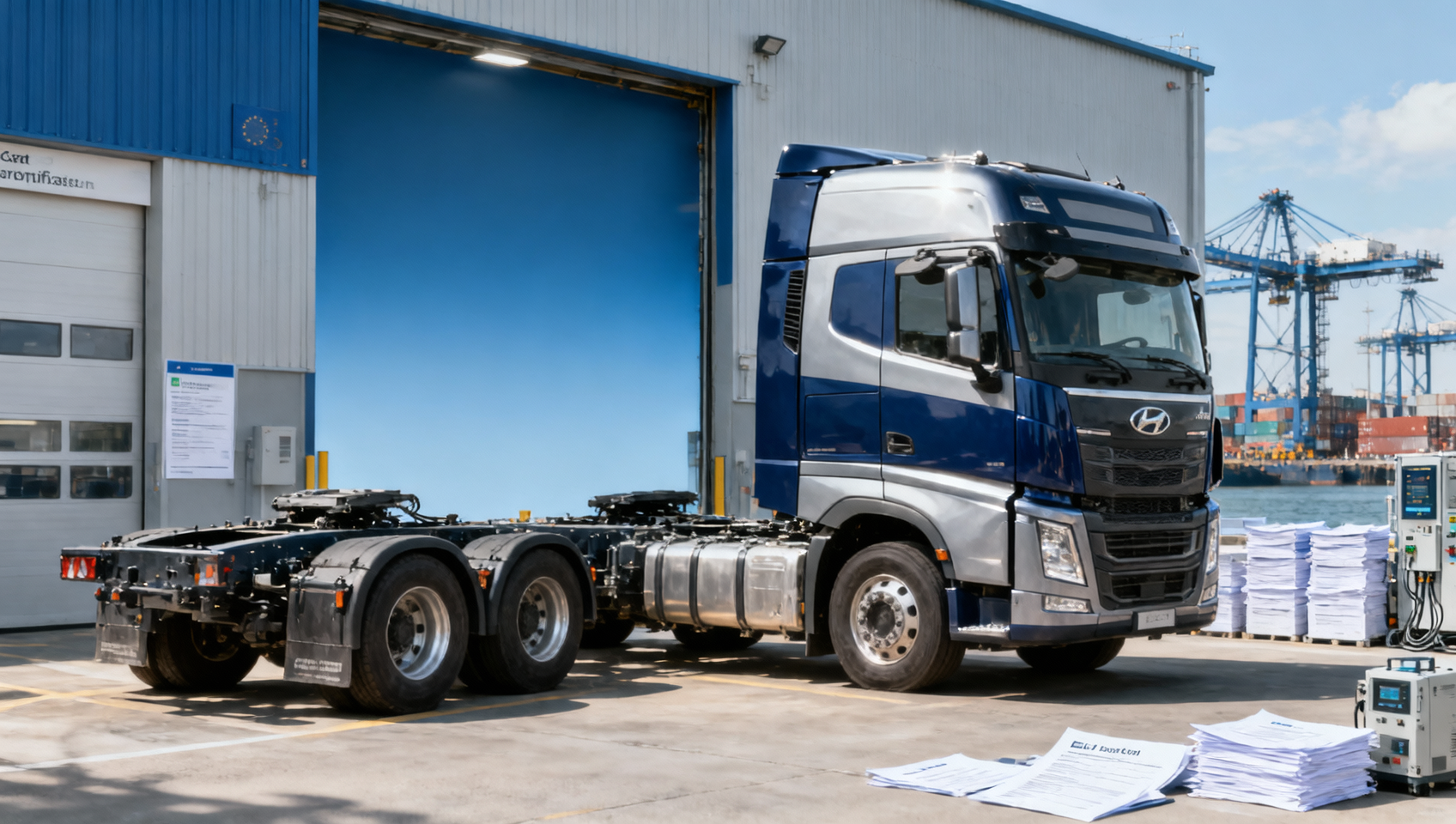
On July 7, 2026, the European Commission updated its Heavy-Duty Vehicle CO₂ Compliance Manual, introducing a clear compliance change for heavy trucks entering the EU market. From October 1, 2026, imported heavy trucks, including chassis, complete vehicles, and modified vehicles, will need to pass a new carbon-intensity verification module within EU Type-Approval and include a carbon footprint declaration from the Chinese manufacturer under EN 15804+A2:2023. This is worth close industry attention because it does not only affect formal certification steps; it also reaches export documentation, delivery timing, and the practical coordination between manufacturers, certification teams, and buyers.
What the updated manual now requires
The confirmed change is tied to the European Commission’s July 7, 2026 update of the Heavy-Duty Vehicle CO₂ Compliance Manual. According to the provided event summary, from October 1, 2026, all heavy trucks imported into the EU must complete a new carbon-intensity verification module as part of EU Type-Approval.
The requirement applies to imported heavy trucks including chassis, complete vehicles, and modified vehicles. The same update also requires submission of a carbon footprint declaration from the Chinese manufacturer, based on EN 15804+A2:2023.
The provided information further states that this change directly affects the type-approval route, delivery cycle, and documentation preparation cost for Chinese heavy-truck exporters.
Where the pressure is likely to appear first
Export certification work moves earlier in the process
From an industry perspective, exporters are likely to feel the impact first because the new requirement is tied to EU Type-Approval rather than only to commercial shipment paperwork. That means the compliance burden may appear before delivery, in the certification path itself. What deserves closer attention is whether existing approval planning, document sequencing, and coordination with technical partners remain workable under the new carbon verification step.
Manufacturers will need tighter carbon-document preparation
Chinese manufacturers may be affected because the update explicitly requires a carbon footprint declaration under EN 15804+A2:2023. In practical terms, the pressure point is not only producing vehicles that meet customer specifications, but also preparing supporting declarations in a form that can be used in the approval process. Companies involved in manufacturing, vehicle completion, or modification should therefore pay attention to whether their internal technical files, product data collection, and compliance records are aligned with this added requirement.
Procurement and delivery planning may become less flexible
Buyers, sourcing teams, and supply-chain service providers may also be affected because any added verification step can influence scheduling, document readiness, and handover timing. Analysis shows that the rule change is relevant not just to exporters themselves, but also to those arranging orders, delivery windows, and cross-border coordination. The main issue to monitor is whether certification timing and document completion begin to shape procurement lead times more directly than before.
Testing and compliance support functions may face a larger role
Certification-related service providers and testing support organizations may see a more active role in transaction execution, since the new requirement sits at the intersection of technical approval and carbon documentation. Observably, the immediate relevance is procedural: participants in the approval chain may need to check whether current document packages, review steps, and customer-facing compliance submissions are still sufficient once the new module becomes mandatory.
What companies should watch before October 2026
Review whether approval files already match the new module
Analysis shows that companies exporting heavy trucks to the EU should first review how the new carbon-intensity verification module fits into their current EU Type-Approval workflow. The key question is whether current approval files, supporting technical materials, and submission timing already cover the added verification requirement, or whether additional preparation will be needed.
Check readiness of the carbon footprint declaration
What deserves closer attention is the carbon footprint declaration requirement linked to EN 15804+A2:2023. The provided information does not supply detailed execution criteria, so it would be premature to assume a settled market practice. Even so, manufacturers and export teams should closely track how this declaration is expected to be prepared, reviewed, and incorporated into approval documentation.
Reassess delivery commitments and contract timing
Because the update is described as directly affecting delivery cycles and documentation preparation cost, companies with ongoing or upcoming EU-bound orders should pay attention to lead-time assumptions in contracts, order planning, and shipment scheduling. This is especially relevant where delivery commitments depend on a fixed approval sequence or where modified vehicles require additional coordination before market entry.
Monitor how the requirement appears in customer-facing documents
Observably, another practical issue is whether the new rule begins to appear in procurement documents, technical specifications, bid materials, or buyer compliance checklists. The input does not confirm how market participants will apply the requirement in commercial practice, so this remains an area for continued monitoring rather than a concluded outcome.
Why this looks like an execution signal, not just a policy note
Analysis shows that this update is more appropriate to understand as an execution signal with a defined implementation date, rather than as a general policy discussion. The rule change is specific in scope, links directly to EU Type-Approval, and identifies both a mandatory verification module and a supporting declaration requirement.
At the same time, it should not yet be overstated as a fully settled operating pattern across every transaction scenario. Observably, the supplied information confirms the requirement and its implementation date, but does not provide the full detail of review practice, document interpretation, or market-wide enforcement rhythm. That is why continued attention to later official wording, approval practice, and industry feedback remains necessary.
How this update is best understood now
The immediate significance of this development is that carbon-related compliance is moving closer to the front end of market access for imported heavy trucks entering the EU. For Chinese exporters, the issue is no longer limited to product delivery or customer acceptance; it is connected to certification routing, documentary readiness, and the timing of order execution.
Current observation suggests this should be read as a concrete compliance change with near-term operational implications, while some execution details still require follow-up. A measured industry response is therefore to treat the requirement as real and time-bound, while continuing to verify how approval practice and document expectations develop in implementation.
Basis of this article and what still needs verification
This article is based on the user-provided news title, event date, and event summary. The summary states that on July 7, 2026, the European Commission updated the Heavy-Duty Vehicle CO₂ Compliance Manual and set a mandatory carbon-intensity verification module within EU Type-Approval for imported heavy trucks from October 1, 2026, together with a Chinese manufacturer carbon footprint declaration under EN 15804+A2:2023.
For events of this kind, relevant source categories typically include official notices, regulator publications, customs or trade administration releases, industry association updates, standards documentation, and reporting by authoritative trade media. A specific official source link was not provided in the input, so it still needs to be checked on an ongoing basis.
Follow-up attention should remain on detailed policy wording, certification interpretation, changes in procurement or tender documentation, industry feedback, and how companies implement the new requirement in actual export and approval workflows.
Send Us A Message